

Events
Professor Zhang Zhijun's Team from School of Medicine Makes Series of Advances in Molecular and Neural Mechanisms of Acute/Chronic Pain and Itch
Recently, the research team on acute and chronic pain and itch, led by Professor Zhang Zhijun from the Department of Human Anatomy at the School of Medicine, has made continuous progress in elucidating the molecular and neural mechanisms underlying these conditions, with related findings published in several internationally renowned journals.
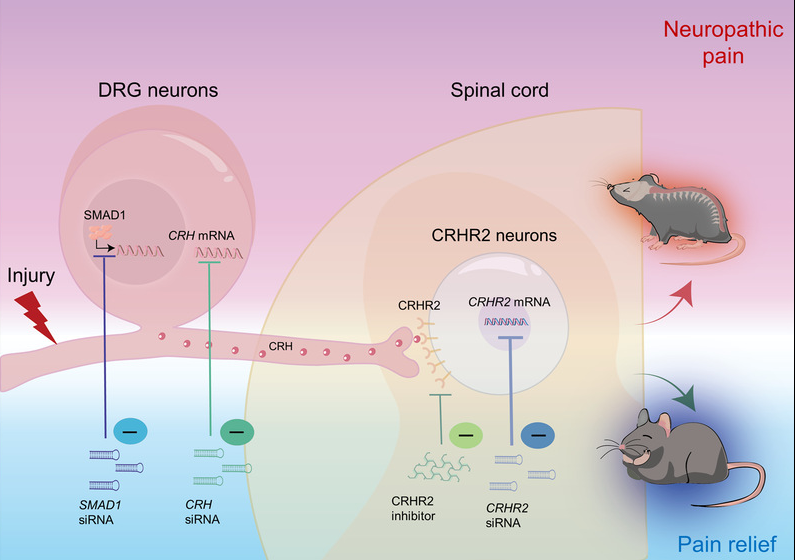
The team focused on the core mechanisms of chronic neuropathic pain and deeply investigated the regulatory role of the classical stress neuropeptide CRH in the dorsal root ganglion (DRG). For the first time, they fully elucidated the mechanism of the SMAD1–CRH–CRHR2 peripheral–spinal pain signaling axis, challenging the traditional view that CRH is only involved in central pain regulation. Their work clearly identified peripheral CRH as a key driver of central sensitization in chronic pain. This signaling axis, with its clear hierarchy and specific targets, provides precise intervention directions for analgesic drug development. The related findings were published in Science Signaling, a journal of the Science family, under the title "SMAD1-mediated induction of peripheral CRH after nerve injury promotes neuropathic pain by activating spinal CRHR2." Professor Zhang Zhijun and Professor Gao Yongjing are co-corresponding authors, with He Cheng, Ma Lingjie, and Fu Yuanyuan as co-first authors.
Following their 2025 publication in Neuropharmacology revealing the role of ANXA2 in DRG neurons mediating chemotherapy-induced pain, the team further confirmed that ANXA2 is a key pathogenic gene in keratinocytes of atopic dermatitis. By regulating STAT3 phosphorylation, ANXA2 mediates inflammation and itch, and this pathway's pathogenic role was validated in clinical samples. Through screening, they identified the natural compound micheliolide (MCL), which can target and block the ANXA2–STAT3 pathway, significantly improving dermatitis lesions in model mice. This provides a new target and a natural lead compound for the targeted treatment of atopic dermatitis. These results were published in Phytomedicine under the title "Micheliolide directly targets keratinocyte Annexin A2 to abrogate STAT3-driven inflammation and pruritus in atopic dermatitis," with Professor Zhang Zhijun, Liu Su, and Guo Jianshuang as corresponding authors, and Zhang Yuqi, Wang Ji'an, Li Longfei, and Chen Xuewen as co-first authors.
Additionally, the team discovered that the neuropeptide NPTX2 in peripheral sensory neurons is a key regulator of chronic itch in atopic dermatitis, elucidating a novel neuro-immune interaction mechanism and providing a new target for precise treatment of chronic itch. The related work was published in International Immunopharmacology under the title "Neuronal pentraxin 2 in peripheral sensory neurons drives chronic itch through potentiation of the interleukin-31/interleukin-31 receptor pathway in atopic dermatitis," with Professor Zhang Zhijun as corresponding author, and Bai Xueqiang, Wu Bingxin, and Wang Ji'an as co-first authors.
https://news.ntu.edu.cn/2026/0522/c8062a291599/page.htm
